The Reality Check: Why DIY Paint Fails
It is a crisp Sunday morning in Surrey. You are walking back to your car in the supermarket car park, only to spot it: a fresh, glaring scratch on your rear bumper or front wing. Your first instinct is an completely understandable desire to save a bit of money and time.
An hour later, you find yourself standing in front of a massive wall of colour-coded aerosol bottles at Halfords, holding a £15 spray can labeled with your car’s exact paint code. You think to yourself, “How hard can it be? It’s just a quick spray and wipe.”
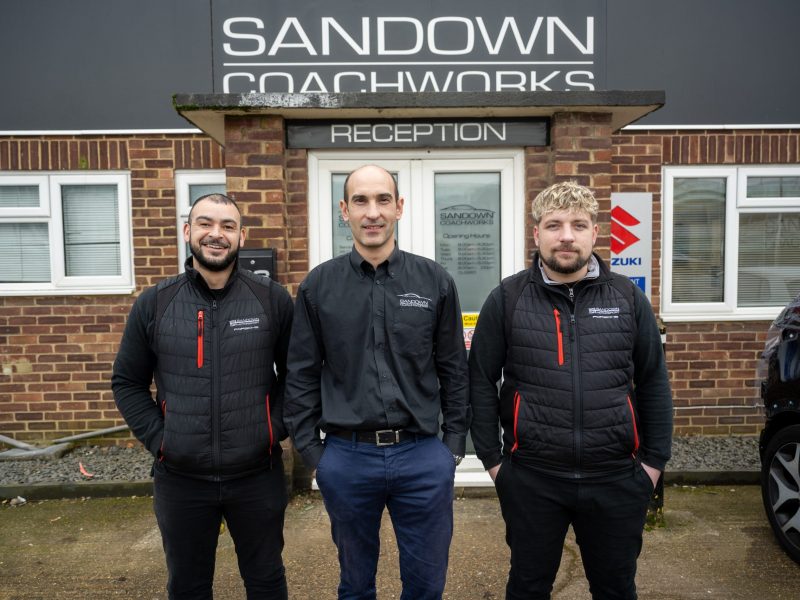
It is a tempting thought. However, as an independent, British Standards BSI 10125 Certified accident repair specialist with decades of collective experience across our workshops in Camberley, Shepperton, and Heathrow, we see the aftermath of these Sunday afternoon DIY adventures all too often.
Here is the technical reality of why those off-the-shelf aerosol kits rarely provide the factory finish you expect, and why a quick DIY fix can often lead to a much larger bill down the line.
The Paint Code Variance Trap
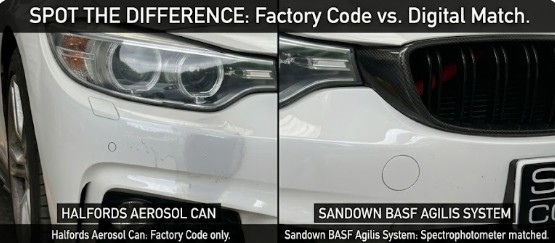
The biggest misconception about modern automotive refinishing is that a factory paint code represents one single, universal shade. If your Volkswagen paint code is LC9X (Deep Black) or your Ford is Moondust Silver, you might assume that buying a can with that exact label ensures a perfect match.
In reality, vehicle manufacturers use multiple paint suppliers (such as BASF Agilis, PPG, or Axalta) across different global factories and production batches. Consequently, for any single factory paint code, there can be anywhere from 3 to 10 distinct “shade variants”—some may have greener undertones, others redder, lighter, or darker.
Furthermore, environmental factors like UV exposure continuously fade your car’s original paintwork over time. A brand-new aerosol formula mixed to standard factory specifications will almost always clash with your car’s beautifully aged paintwork.
At Sandown Coachworks, our technicians do not rely on guesswork or off-the-shelf cans. We utilise advanced digital spectrophotometers—specialist colour-matching cameras—combined with our state-of-the-art BASF Agilis water-based paint system to calculate the exact, unique shade variant of your car as it stands today. We then mix the formula down to the precise micro-gram.
Driveways vs. Low-Bake Spray Booths
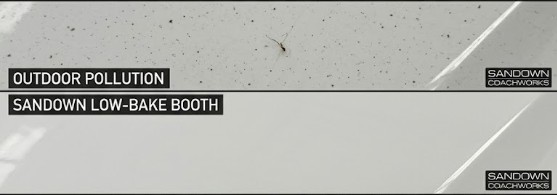
Applying automotive paint is highly sensitive to the surrounding environment. Trying to spray a panel on a driveway or inside a residential garage leaves the finish exposed to uncontrollable airborne enemies:
- The British Weather: Atmospheric moisture and unexpected drops in temperature can cause automotive paint to “bloom,” leaving a hazy, cloudy white moisture film locked beneath the lacquer.
- Debris: Microscopic dust particles, pollen, and insects are naturally attracted to wet paint, creating permanent, gritty textures on the surface.
To achieve a flawless, mirror-like gloss, the environment must be completely controlled. Our workshops feature heavily filtered, dust-free, low-bake spray booths. These systems extract all airborne contaminants and maintain a precise, elevated temperature to allow the paint to cure evenly, ensuring structural integrity and a uniform gloss.
The Technical Limits of Aerosol Pressure
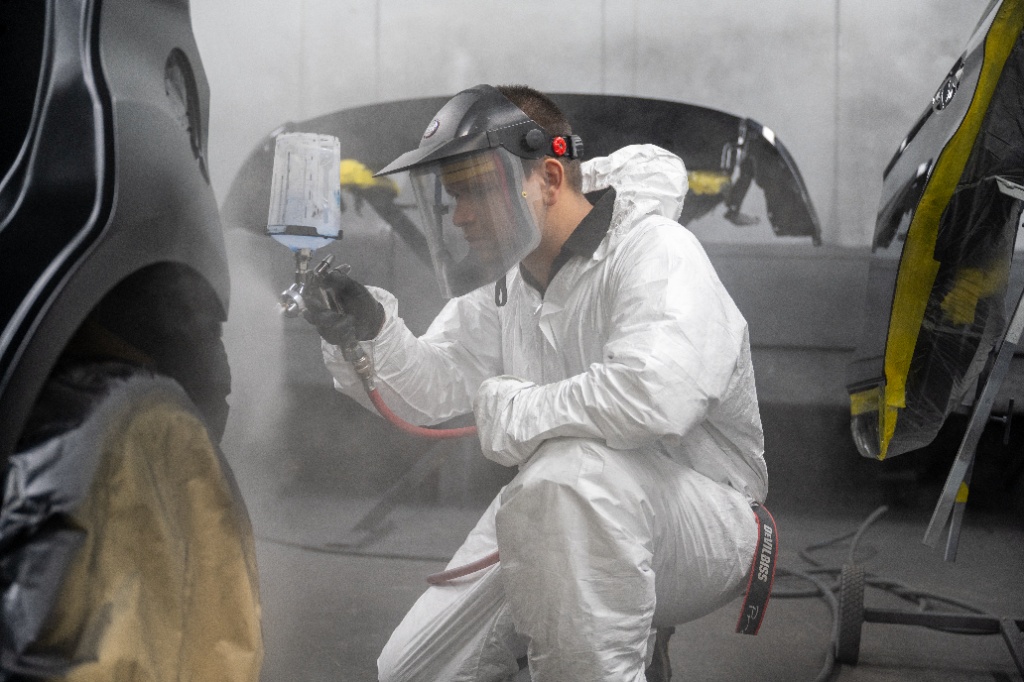
Professional refinishing relies heavily on the atomisation of liquid paint. Our high-volume, low-pressure (HVLP) spray guns are connected to stable, regulated air compressors. This equipment breaks the paint down into a microscopic mist, allowing our painters to smoothly “blend” the fresh coat into the surrounding original paintwork for an invisible transition.
An aerosol can from a local auto shop, by contrast, relies on a primitive internal propellant. As the internal pressure fluctuates, the nozzle can spit, sputter, and distribute paint unevenly. This pressure variance leads to:
- The “Orange Peel” Effect: A thick, dimpled texture resembling the skin of an orange.
- Metallic Settling: On silver, grey, or metallic finishes, heavy metallic flakes sink unevenly, creating dark, patchy smudges across the panel.
- Paint Runs: Excessively heavy paint application on vertical surfaces, resulting in thick, unsightly drips.
The 1K vs. 2K Clearcoat Problem
Most DIY aerosol kits include a “1K” (one-part) clearcoat lacquer that air-dries over a few hours. Because it lacks a chemical hardening agent, 1K lacquer remains relatively soft. It can easily be dissolved or stripped away by everyday occurrences like petrol spills at the pump, harsh winter road salt, or acidic bird droppings.
In our professional body shops, we seal our paintwork using premium “2K” (two-part) clearcoats. These contain hardeners that undergo a fast chemical reaction inside our baking ovens, transforming the liquid into a rock-hard, UV-resistant shield that permanently locks out the elements and matches the durability of your car’s factory build.
The False Economy of Sunday DIY
Attempting a DIY fix often results in a classic false economy. Consider the breakdown:
The DIY Sunday Experience
• Aerosol Paint, Primer & Clearcoat:     £35.00
• Assorted Sandpaper & Masking Tape:    £15.00
• Prep Wipes & Degreasers:               £10.00
• A Ruined Sunday Afternoon:             Priceless
--------------------------------------------------
Total Out-of-Pocket Cost:               £60.00
Actual Result: A patchy, dull, mismatched panel.
The real financial impact is felt when it comes time to trade in or sell your vehicle. Dealerships and private buyers will immediately spot a poor DIY repair. It instantly signals that the car has suffered damage, potentially knocking hundreds or thousands of pounds off its valuation.
Furthermore, correcting a botched DIY job requires our team to completely sand back and chemically strip away the soft aerosol layers before we can even begin a correct, certified structural repair. This extra labour can end up making the professional repair more complex than it originally needed to be.
Save Your Weekend (And Your Resale Value)
Before you buy a spray can and risk your car’s finish, let our team take a look. You can easily upload a photo of your vehicle’s damage directly through our online estimation tool to receive a clear, transparent, and accurate estimate.
Get a free, professional assessment today:
- Camberley Workshop: 01276 408112
- Shepperton Workshop: 01932 240471
- Heathrow Workshop: 020 8755 1850
- Online Estimates: Sandown Coachworks Estimate Portal
Whether you drive a daily commuter or a prestige vehicle in Surrey, Greater London, or Berkshire, our teams at Camberley, Shepperton, and Heathrow are equipped.